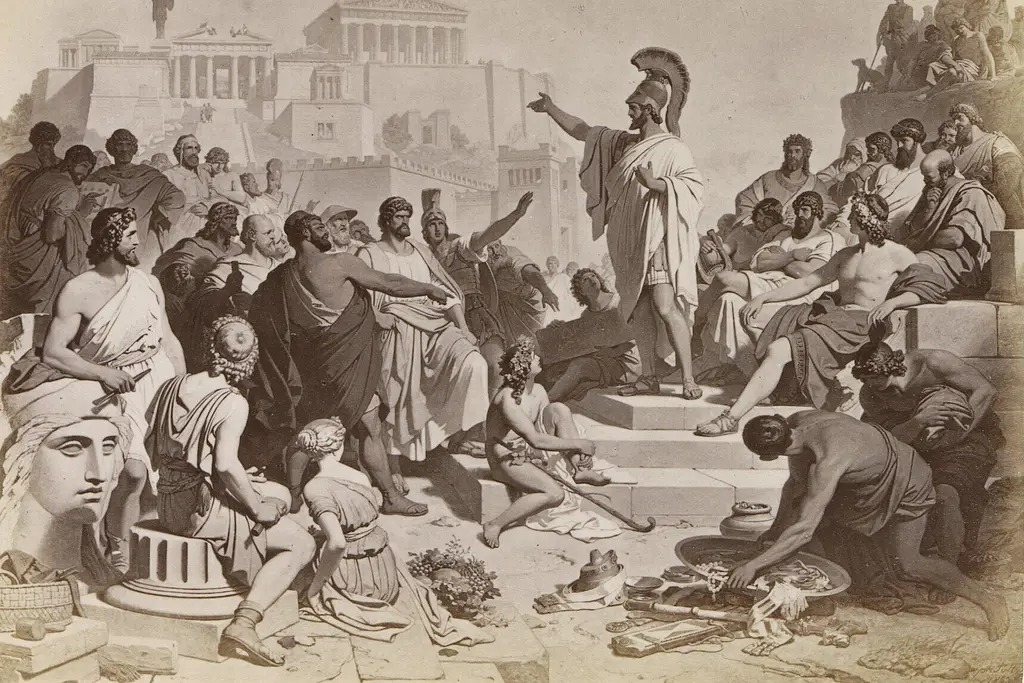
1Our constitution does not copy the laws of neighbouring states; we are rather a pattern to others than imitators ourselves. Its administration favours the many instead of the few; this is why it is called a democracy.
2If we look to the laws, they afford equal justice to all in their private differences; if to social standing, advancement in public life falls to reputation for capacity, class considerations not being allowed to interfere with merit.
3Nor again does poverty bar the way; if a man is able to serve the state, he is not hindered by the obscurity of his condition.
4The freedom which we enjoy in our government extends also to our ordinary life. There, far from exercising a jealous surveillance over each other, we do not feel called upon to be angry with our neighbour for doing what he likes.
5We throw open our city to the world, and never by alien acts exclude foreigners from any opportunity of learning or observing, although the eyes of an enemy may occasionally profit by our liberality.
6For we trust not so much to system and policy as to the native spirit of our citizens; while in education, where our rivals from their very cradles by a painful discipline seek after manliness, at Athens we live exactly as we please, and yet are just as ready to encounter every legitimate danger.
7We cultivate refinement without extravagance and knowledge without effeminacy; wealth we employ more for use than for show, and place the real disgrace of poverty not in owning to the fact but in declining the struggle against it.
8An Athenian citizen does not neglect the state because he takes care of his own household; and even those of us who are engaged in business have a very fair idea of politics. We alone regard a man who takes no interest in public affairs, not as a harmless, but as a useless character.
9Instead of looking on discussion as a stumbling-block in the way of action, we think it an indispensable preliminary to any wise action at all.
10In short, I say that as a city we are the school of Hellas; while I doubt if the world can produce a man who, where he has only himself to depend upon, is equal to so many emergencies, and graced by so happy a versatility, as the Athenian.
11For heroes have the whole earth for their tomb; and in lands far from their own, where the column with its epitaph declares it, there is enshrined in every breast a record unwritten with no tablet to preserve it, except that of the heart.
12These take as your model and, judging happiness to be the fruit of freedom and freedom of valour, never decline the dangers of war.
Already have an account? Log in